RESIDENTS
conversations
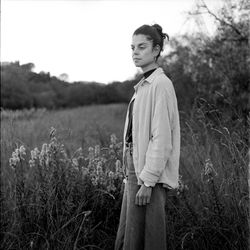 |6| Laura Cemin Maker 9.11.25 / 15.11.25 |
|---|
"At the center of the work lies one fundamental action: to hold. Through this simple act, personal and collective movement languages find shared pulses and common threads. Each form, holding its own social and political resonance, echoes stories of migration, adaptation, and belonging".
 |6| Bianca Hisse Maker 9.11.25 / 15.11.25 |
|---|

-
Few principles that guide us…
To start with the body.
To trust that movement can carry complex political and affective questions, without needing to illustrate them.
To listen to how the body insists on its own rhythm.
To create scores that leave space for the performers' subjectivities, individualities, and vulnerabilities.
To embrace not-knowing.
-
Our research demands time. It demands the ability to repeat, stretch, and undo materials. It demands a space where we can physically exhaust ideas. It demands a shift between intense physical work and reflection: writing, talking, and mapping what emerges in the studio.
-
We would describe ourselves as makers interested in friction: between softness and firmness, between play and tension, between individual biographies and larger histories. We come from different backgrounds, but we share a fascination about how bodies shape language and vice-versa, how they negotiate boundaries, whether that is social, economic, or choreographic.
-
The central question at this moment is how do traditions shift, move and change? Which marks leave on the body and what is the role of dance in this? What threads of home do we carry across borders? What is held against, and what must be left behind?
-
We describe our work as physical, conceptual and compositional: in AGARRRA, the project we are working on here in the residency, this takes the form of energetic movement languages that are constantly negotiating balance and imbalance. Agarrar in Portuguese and Spanish means to grab, to hold, to cling to. Someone “agarrando” something is not just touching it.
The title points to this fundamental choreographic action of the piece: to hold weight, to hold space, to hold each other, to hold a tradition, to hold a border inside the body. There is also an ambiguity between grabbing with force or with softness.
“Agarras” as objects can also mean the grips on a climbing wall. In the context of this piece, “agarras” are not only physical points but also rhythms, gestures, cultural references, and micro-histories. Phonetically, Agarrra also behaves like an onomatopoeia. The rolling “rrr” stretches into a sound of friction, breath, or effort, almost like the sound of someone pulling themselves up, tightening their grip, or exhaling. It sits somewhere between a grunt, a growl, and a laugh. This makes the title less like a fixed word and more like a vocal gesture. In our title we included an extra “r”: Agarrra. For speakers of Portuguese/Spanish, the triple “r” is slightly off; for non-speakers, it might be just a strange, stretched sound. In both cases, it carries a sense of displacement: the word is from somewhere, but not exactly “at home” in any one language.
-
This project is a landscape to inhabit, rather than to watch from afar. At the center of the work lies one fundamental action: to hold. Through this simple act, personal and collective movement languages find shared pulses and common threads. Each form, holding its own social and political resonance, echoes stories of migration, adaptation, and belonging. Agarrra traces the ever-changing nature of cultural traditions, continually preserved, adapted, and reinvented through diasporic narratives.
-
Our personal routine looks somewhat like this: Laura (the early bird) rolls out her mat before sunrise, while Jorge prepares himself a glamorous breakfast. Bianca grinds her coffee, while everyone else wakes up. We meet in the studio at 10:00. Rehearsals begin with a short recap of the previous day and an introduction to the day’s themes and references (we structure the rehearsal based on aspects we are interested in exploring). We warm-up together, usually with games and simple tasks, after which we dive into the work until hunger reminds us to pause. After lunch, we return to the studio. In theory, we finish at 16:00, but more often it’s closer to 17:00. Our collaborators usually stay a bit longer to unwind and process the day, while we (Laura and Bianca) move on to the practical, and often less pretty, tasks that come with making a piece. Evenings tend to be full of laughter.
-
We think this space is a kind of amplifier. La Cap gave us a perfect context to start off this work: studio time, quietude, calmness and proximity to each other. The surroundings and atmosphere invites us to expand and reflect, it feels intimate in a way that is both grounding and generative.

© An exchange between Laura Cemin, Bianca Hisse and Silvia Giordano
Bianca Hisse (Brazil/Norway) and Laura Cemin (Italy/ Finland) both operate at the intersection of visual art, performance and choreography. Their work, often presented in galleries and non-traditional performance spaces, focuses on language and on how contemporary discourses influence mobility and social circulation. They have been exploring such topics in their individual practices while developing their collaborative body of work.
During their residency at La Cap, they continued the development of AGARRRA, a stage work that explores how migration and cross-border movements have shaped the evolution of dance over time together with the performers Ornilia Percia Ubisse, Valentina Martinez Mariscal, Jorge Ciprianno, Aiswarya Prathap.
The project investigates the relationship between folk dances and contemporary practices, examining how movements across borders influence the transmission of these dances and how certain movement patterns are preserved or transformed in the process. The work is set to premiere in at Bærum Kunsthall in 2026.